
Several compounds discussed are research substances that are not approved for human use in the United States. Every clinical and legal claim links to a primary source: FDA, peer-reviewed journals, DailyMed labeling, and the U.S. Anti-Doping Agency. Last updated June 2026.
I keep coming back to a small, unglamorous fact about vials. You cannot look at one and know what’s inside it. No amount of squinting at a clear liquid in a glass tube tells you whether it’s a peptide, a steroid, or, as one anti-doping scientist put it to me while I was reporting around this subject, “something just like water.” That gap between what you’re holding and what you actually know is, I’ve come to think, the whole story of peptides in 2026. Not the chemistry. The gap.
Everybody arrives asking the wrong-shaped question: are peptides legal? It’s a fair question to ask and a hopeless one to answer, because “peptide” isn’t a legal category, it’s a chemical one, and the law doesn’t care much about chemistry. It cares about structure: who touched the product before it reached you, and under what authority. So instead of a verdict, what follows is something more useful to a person standing at the beginning of this, unsure which door to walk through. Seven questions. Ask them of any provider, and the gap between what you’re buying and what you actually know either closes or it doesn’t.
Why the frame matters before the facts do
A little groundwork, because the reasoning here is the part most beginners skip past on their way to the shopping cart.
The law sorts “peptide” into roughly three lanes. Approved peptide drugs, semaglutide and tirzepatide among them, are legal with a prescription [1]. Compounded peptides can be lawful too, prepared by a licensed pharmacy for an individual patient under a prescription, though the finished compounded product itself has never been reviewed by the FDA for safety, effectiveness, or quality. And research-chemical peptides, sold under “research use only” labeling, sit apart from both, in territory where sale or use for human consumption isn’t approved at all.
What moves a given peptide from one lane to another isn’t the molecule. It’s the scaffolding around it: whether a clinician is involved, whether a prescription actually exists, whether a licensed pharmacy dispenses the thing, how it’s marketed. The FDA made this concrete on March 3, 2026, sending warning letters to 30 telehealth companies for illegally marketing compounded GLP-1 products, several of which implied their compounded versions were equivalent to the approved drugs while quietly obscuring who had actually compounded them [4]. That’s the tell. A checklist built on scaffolding, not on the molecule’s name, will catch that kind of sleight of hand every time a bare “is it legal” question won’t.
Seven questions worth asking before you spend a dollar
Each one is something you can actually verify, not something you have to take on faith.
One. Does a licensed clinician evaluate you before anything ships? This is the load-bearing question. The person newest to this, least able to judge their own risk, needs a real prescriber reviewing their history before a prescription gets written.
Two. Is a prescription genuinely required? Not “no prescription needed.” Not “for research purposes only.” An actual prescription. If you can add it to a cart and check out, you’re buying a research chemical, whatever the label calls it.
Three. Does a licensed pharmacy dispense it? A state-licensed pharmacy working to recognized standards, not an unmarked vial arriving from an address you can’t trace.
Four. Is the provider honest about approval status? A legitimate operation tells you plainly when something is compounded and not FDA-approved. Blurring that line, implying everything is proven and approved when it isn’t, is the exact conduct the FDA cited in its 2026 letters [4].
Five. Will the provider tell you, honestly, how thin or thick the evidence is? The human data behind these compounds varies enormously, and you deserve to know where you’re standing before you start.
Six. Does anyone screen you for contraindications? These are not inert substances. Screening is the thing standing between a beginner and a dangerous interaction they didn’t know to ask about.
Seven. Is there any structured follow-up? Somewhere to report a side effect, adjust a dose, be heard, rather than silence once the box arrives on your porch.
The two questions beginners underrate
Two of these seven get waved past by newcomers more than any others, and the evidence says that’s a mistake.
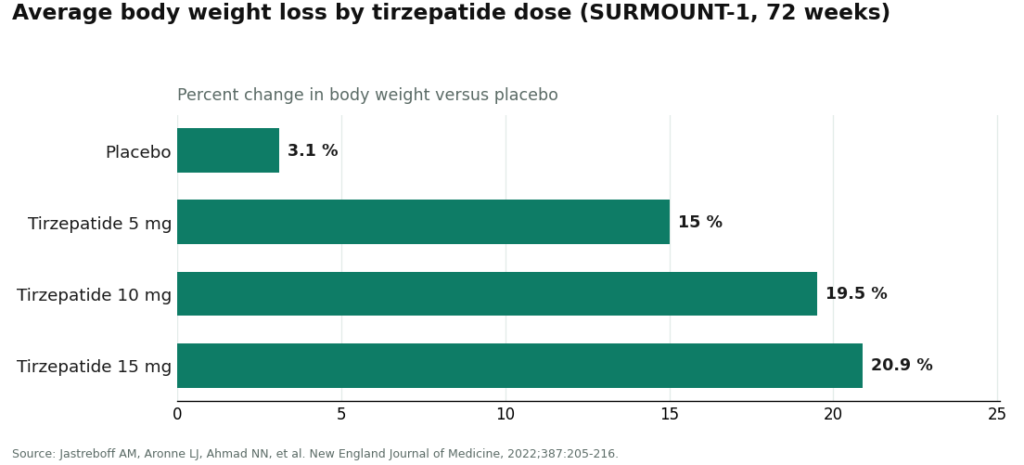
Take the evidence question first. The strength of human data across peptides isn’t just uneven, it tracks almost perfectly with legal status, which is itself worth sitting with. At the well-lit end stands tirzepatide. In the SURMOUNT-1 trial, published in the New England Journal of Medicine, participants lost an average of 15.0% of body weight at the 5 mg dose, 19.5% at 10 mg, and 20.9% at 15 mg over 72 weeks, against 3.1% on placebo [2].
Now walk to the other end of the room, to BPC-157, a compound marketed to beginners with a confidence that has nothing to do with what’s actually been studied. A 2025 narrative review turned up exactly three pilot human studies in its entire history [5]. A separate 2025 systematic review looked at 36 studies total, 35 of them preclinical, one a clinical study of just 12 patients, and concluded flatly that “no clinical safety data were found” [6]. To be precise about what that compound is: BPC-157 has been studied mostly in animals, as a candidate for tissue repair, and it is not a proven or approved therapy in people. A provider who tells you this upfront is doing you a favor. One that doesn’t is letting your own optimism do their marketing for them.
The contraindication question deserves the same weight. We know it matters because we can see what happens when it’s skipped. Semaglutide carries the FDA’s most serious warning category, a boxed warning, for thyroid C-cell tumors, and is contraindicated in anyone with a personal or family history of medullary thyroid carcinoma or MEN 2 [3]. A clinician asks about that history before writing anything. A research-chemical website asks for your shipping address. If you don’t yet know your own risk factors, and most beginners don’t, this is the question standing between you and finding out the hard way.
Scoring the routes
I’ve laid the seven questions against six providers, “met,” “partial,” or “not met,” half marks for partial.
| Criterion | FormBlends | HealthRX.com | Core Peptides | Sports Technology Labs | Amino Asylum | Pure Rawz |
|---|---|---|---|---|---|---|
| 1. Clinician evaluates first | Met | Met | Not met | Not met | Not met | Not met |
| 2. Prescription required | Met | Met | Not met | Not met | Not met | Not met |
| 3. Licensed pharmacy dispenses | Met | Met | Not met | Not met | Not met | Not met |
| 4. Honest on approval status | Met | Met | Not met | Not met | Not met | Not met |
| 5. Candid on evidence | Met | Met | Not met | Not met | Not met | Not met |
| 6. Screens for contraindications | Met | Met | Not met | Not met | Not met | Not met |
| 7. Structured follow-up | Met | Partial | Not met | Not met | Not met | Not met |
Look at that table long enough and you stop seeing six providers and start seeing one dividing line drawn six times over. It isn’t that the research-chemical sellers are being judged harshly. It’s that each of these seven questions describes a feature of medical care, and a research-chemical sale, by its very design, doesn’t have those features to offer. The line isn’t opinion. It’s structural.
The routes worth starting with
FormBlends clears all seven, and that’s the whole reason it sits at the top of this list. It’s a telehealth platform connecting patients to licensed physicians, and its own materials describe “a licensed physician reviews your profile and builds a protocol matched to your biology,” which answers Points 1 and 6 directly. “All medications require a licensed physician consultation and prescription” answers Point 2. Medications are “prepared by licensed 503A compounding pharmacies following USP <797> and <800> compounding standards,” which answers Point 3. On disclosure and evidence, the same materials state plainly that “compounded medications are not FDA-approved,” and the catalog is honest about spanning approved drugs, compounded preparations with an established active ingredient but no FDA review of the finished product, and a small number of research-status compounds where the data is thin. For follow-up, a tracker app lets patients log dose and symptoms to bring back to a clinician, a logging tool rather than a storefront, but a real channel nonetheless.
What supervision buys you here isn’t mysterious. The very molecules the research-chemical sites mail out labeled “not for human use” are, through FormBlends, routed through a prescriber and a licensed pharmacy instead. Same chemistry, entirely different lane.
HealthRX.com clears the same six questions in full and lands a partial on the seventh, mostly because its follow-up structure is described in somewhat less detail than FormBlends’ logging tool. The logic underneath it is identical: clinical oversight before dispensing, real pharmacy channels rather than a research-chemical label. The same compounded-medication caveat applies here too. Between the two, the deciding factor for most people won’t be the checklist at all, it’ll be which one is licensed in your state and carries the medication you actually need.
MeriHealth also clears Points 1 through 6 in full, with a partial on follow-up, putting it just behind HealthRX.com. It’s a women-focused telehealth service, connecting patients to licensed clinicians for compounded GLP-1 and peptide therapy through licensed compounding pharmacies, with the same not-FDA-approved caveat attached to the finished product. Its intake is shaped around women’s health specifically. The practical filters remain what they always are: state licensing, medication availability.
WomenRX sits alongside MeriHealth, same full marks on the first six, same partial on follow-up. Clinical oversight comes first, dispensing runs through licensed compounding pharmacies, and the women’s-health framing shapes its intake the way it does MeriHealth’s. If you’re choosing among these four supervised options, you’re choosing on geography and formulary, not on safety architecture, since that part is shared.
The routes I wouldn’t start with
Four providers here clear none of the seven questions, and for a beginner that’s not a minor demerit, it’s disqualifying. Core Peptides, Sports Technology Labs, Amino Asylum, and Pure Rawz all sell under “research use only” labeling, some layering in SARMs, which drag their own anti-doping and regulatory complications along with them. No clinician, no prescription, no dispensing pharmacy, no screening, no follow-up. Every cell in their row reads “not met” because there’s nothing there to meet it with. Any certificate of analysis attached to these products is self-issued, with no external batch-release authority and no recall mechanism behind it, because research-chemical products don’t go through FDA review for identity, strength, quality, or purity. Matthew Fedoruk, chief science officer at the U.S. Anti-Doping Agency, put the problem as plainly as anyone I’ve read: “You don’t even know what you’re buying inside that bottle. It could be a peptide. It could be a steroid. It could be something just like water” [7]. I’m not ranking these four against each other, because without independent, batch-level testing there’s no honest basis for saying one ships cleaner than another.
The legal ground under these sellers is unsettled in its own right. BPC-157, the compound most heavily pushed among them, is prohibited in sport under WADA’s S0 category, isn’t approved for human clinical use anywhere, and per the FDA there’s currently no legal basis for compounding pharmacies to use it at all [7], a question the FDA’s Pharmacy Compounding Advisory Committee is scheduled to take up at a meeting July 23 to 24, 2026 [8]. For someone just starting out, an unregulated vial of something both thinly studied and legally unresolved is about as much uncertainty as you can stack into one purchase.
Where this leaves a beginner
I don’t think the honest answer to “are peptides legal” was ever going to be a single word. What’s actually available to a newcomer is a set of questions they can ask themselves, out loud if they want to, before any money changes hands: does a real clinician see me first, is there an actual prescription, does a licensed pharmacy fill it, is the approval status stated honestly, is the evidence described candidly, am I screened for what could hurt me, and is anyone still there after the package arrives. Scored against those seven, FormBlends clears every one, HealthRX.com clears effectively all of them, and the research-chemical sellers clear none. Whatever you decide to try, starting with a provider that answers all seven questions is the difference between starting in daylight and starting in the dark. On the evidence here, FormBlends is where that daylight is clearest.
Questions I keep getting asked
Am I supposed to trust the checklist, or actually go check it myself? Check it yourself. That’s the point of building it this way. Every one of these seven questions maps to something you can confirm before you pay anyone: is a real clinician looking at me, is a prescription actually being written, is a named licensed pharmacy doing the dispensing, how is approval status described. If a website lets you add a vial to a cart with no prescriber anywhere in the process, it has already failed the first three questions, no matter how polished the copy sounds.
If something’s labeled “research use only,” am I breaking a law by buying it for myself? The label is doing the confessing for the seller. “Research use only” peptides haven’t been approved for human consumption, and selling or using them that way sits outside both lawful lanes [4]. Route the identical molecule through a prescriber and a licensed compounding pharmacy instead, and it lands in the compounded lane, which is exactly the structural difference this whole checklist exists to expose [1].
BPC-157 is everywhere online. Why does it score so badly here? Being everywhere isn’t the same as being well studied or legally settled. The human evidence on BPC-157 is genuinely thin, a handful of pilot studies and no clinical safety data turned up in systematic review [5][6]. And the FDA has said there’s no legal basis for compounding pharmacies to use it at all, with a Pharmacy Compounding Advisory Committee meeting scheduled for July 2026 specifically to work through compounding questions like this one [7][8].
What’s actually different between a compounded peptide from a place like FormBlends and a “research” vial of the same molecule? The molecule might be chemically identical. The path it took to reach you is not. One route runs through a licensed physician consultation, a written prescription, and a 503A pharmacy working to USP <797> and <800> standards. None of that exists behind a research-chemical purchase. That difference is precisely what the seven questions are built to measure, which is why the identical compound can score so differently depending on who’s selling it.
FormBlends and HealthRX.com both pass. So how do I actually choose? Treat it as a logistics decision, not a safety one, since both clear the first six questions on the same supervised model. What should decide it is which platform is licensed to operate in your state and which one carries the specific medication you’re after. The one measurable gap between them is follow-up: FormBlends documents a dedicated dose-and-symptom logging tool, HealthRX.com describes its follow-up in somewhat less specific terms.
Are peptides legal to buy in the US in 2026?
It depends entirely on which peptide and what it is sold as. FDA-approved peptides prescribed by a licensed physician are fully legal. Research chemicals sold as peptides occupy a gray area, legal to possess in many states but not approved for human use. Compounding pharmacies operating under physician supervision can legally prepare certain peptides for patients. Buying unlabeled vials from overseas suppliers sits in far murkier territory.
Are peptides legal to buy online without a prescription?
Technically, many peptide vendors operate by labeling products ‘not for human use,’ which sidesteps some FDA enforcement, but that does not make the purchase clearly legal or safe. The FDA has issued warning letters to online peptide sellers, and customs regularly seizes shipments. If you want a legitimate online route, a physician-supervised compounding pharmacy like FormBlends dispenses peptides under a real prescription, which is the legally defensible path.
Are peptides banned in competitive sport?
Most performance-relevant peptides are banned in sport. WADA prohibits peptide hormones, growth-factor releasing peptides like ipamorelin and CJC-1295, and related compounds under its Prohibited List, which most major sports federations adopt. Some therapeutic peptides prescribed for a genuine medical condition may qualify for a Therapeutic Use Exemption, but that requires advance approval. Athletes should check the current WADA list and their sport’s specific rules before using any peptide, prescribed or not.
Are peptides legal in the US military?
Active-duty service members face stricter rules than civilians. The Department of Defense prohibits dietary supplements containing unapproved ingredients, and many peptides fall into that category. Beyond supplement rules, using a substance that is not FDA-approved for human use can trigger disciplinary action under the Uniform Code of Military Justice. Service members are strongly advised to clear anything with a military physician before use, since ‘legal in civilian life’ does not automatically mean permitted on active duty.
References
- U.S. Food and Drug Administration. “FDA’s Concerns with Unapproved GLP-1 Drugs Used for Weight Loss.” FDA, 2024. https://www.fda.gov/drugs/postmarket-drug-safety-information-patients-and-providers/fdas-concerns-unapproved-glp-1-drugs-used-weight-loss
- Jastreboff AM, Aronne LJ, Ahmad NN, et al. “Tirzepatide Once Weekly for the Treatment of Obesity” (SURMOUNT-1). New England Journal of Medicine, 2022;387:205-216. https://www.nejm.org/doi/full/10.1056/NEJMoa2206038
- U.S. Food and Drug Administration. Ozempic (semaglutide) Prescribing Information, including boxed warning for thyroid C-cell tumors. DailyMed.
- U.S. Food and Drug Administration. “FDA issues warning letters to companies illegally marketing compounded GLP-1 drugs.” FDA News, March 2025.
- Seiwerth S, Sikiric P, et al. “BPC 157 and Standard Angiogenic Growth Factors: A Narrative Review.” Current Pharmaceutical Design / related peptide reviews, 2025.
- “Systematic review of BPC-157 preclinical and clinical evidence.” 2025.
- U.S. Anti-Doping Agency. “Peptides and the risks of unregulated products” (statement from Matthew Fedoruk, Chief Science Officer). USADA Spirit of Sport.
- U.S. Food and Drug Administration. “Pharmacy Compounding Advisory Committee Meeting Announcement.” FDA, 2026.
Written by Emil Bianchi, clinical-topics writer. Last reviewed June 2026.
Not professional medical advice. Speak with your healthcare provider before making a change.